In the world of infrastructure design, automation is a term every engineer seeks. Writing scripts, defining Ansible playbooks, and building CI/CD pipelines to take the manual labor out of repetitive tasks are practical applications of automation. But at Maavee Systems, we strive for something deeper: Autonomy.
While automation is about doing the work via external triggers, autonomy is about designing systems that handle their own existence.
At Maavee Systems, we know that the pursuit of pure automation often becomes a trap of its own. When you attempt to script every variable, you build rigid tools that fail to adapt to the nuanced realities of different environments. Trying to account for every minor project deviation within a master automation tool is a labor-intensive, never-ending battle. More critically, this forced rigidity strips away the autonomy of a specific engineer, severely degrading experience.
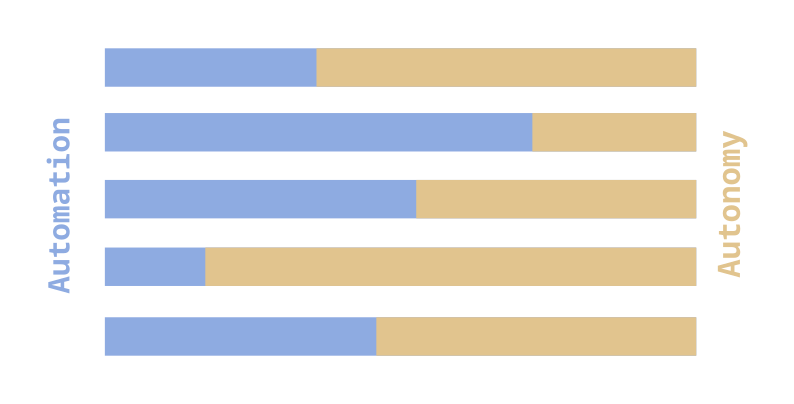
Architecting within a boxed-in mindset stifles creativity, which is not the path to building bespoke and resilient solutions. By recognizing the limitations of both automation and autonomy, Maavee Systems believes that finding the right balance between these two ends brings significant long-term benefits. This balance is never static; in some systems, 70% of the process might be automated, while in others, it may only be 20%.
One practical example for understanding this
In a traditional "automated" environment, you might have a master script that creates a VM, sets its hostname, configures the network interface, and finally updates a central DNS record. This is imperative automation. It's brittle because it relies on every step succeeding in a specific order. If the DNS update fails due to a temporary network hiccup, your "automated" pipeline breaks. You've simply traded manual labor for the labor of maintaining a complex, fragile script.
At Maavee Systems, we take an autonomous approach. We don't write a script to tell the network about the VM; we design the VM and the network to discover each other. We achieve this through a self-resolving architecture:
In this scenario, the "Network Config" step hasn't just been automated, it has been designed out of existence. No one has to map an IP to a name in a database because the system is autonomous. By simply existing and following open protocols, the computing resource becomes reachable by its name across the entire network. Automation removes the effort of the task; Autonomy removes the task itself.
Modern corporate-level cloud providers (Hyperscalers) often make this kind of autonomy difficult, if not impossible. In many VPC, VNet, or VCN environments, up to 80% of standard local network features are disabled or hidden behind proprietary layers.
Instead of allowing a system to function accurately and securely using standard, open protocols, these providers disable the basics and "sell" them back under fancy names and unfair billing cycles.
A new generation of engineers has been trained to assume that paying huge monthly bills for basic service discovery is the "gold standard." At Maavee Systems, we disagree.
The Internet was designed to be open. It was designed to connect the entire world using transparent protocols, not to be a collection of preserved silos where even the most basic connectivity requires a subscription.
Another major obstacle to open, autonomous infrastructure is the artificially generated fear surrounding security. The industry often sells panic to push proprietary products, but we must face a bitter truth: nothing is perfectly secure, and applying heavy-handed "over-security" to every single component creates unnecessary bottlenecks.
Proper infrastructure engineering naturally avoids most of these security bottlenecks without relying on Hyperscaler-provided security appliances. By 2025, OWASP principles and industry data highlight that active monitoring survives the vast, overwhelming majority of attacks, neutralizing all but the absolute rarest of threats. The most effective defense is simply increasing the observability hooks within your system so you can detect and react to anomalies instantly.
However, the Hyperscaler model actively punishes this approach. In a corporate cloud, you cannot freely scale your observability. Each time you increase a metric, add an observability hook, or expand your logging, a thousand-dollar bill awaits you at the end of the month. Hyperscallers penalize the exact practices, transparency and monitoring that keep systems genuinely safe, forcing engineers to choose between blind spots and budget overruns.
At Maavee Systems, we believe that if you have to write a script to fix a manual process, you've achieved automation. But if you design a system where that process is no longer necessary because the components self-resolve using open standards, you've achieved autonomy.
Automation removes the effort. Autonomy removes the worry.

350c, 5th Lane, Ekamuthu Mawatha,
Thalangama North,
Koswatta,
Sri Lanka
27/2, Thalahena,
Negombo,
Sri Lanka
info@maavee.com
+94 76 9244 378
WhatsApp
LinkedIn
 MAAVEE